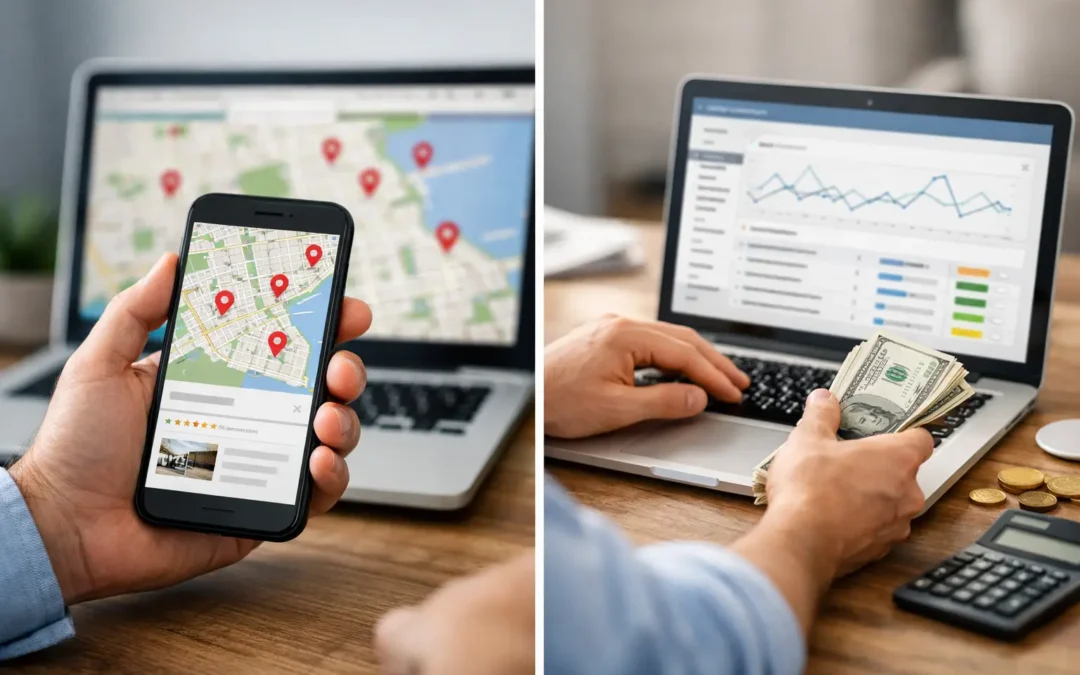
A Calgary contractor can spend $3,000 on Google Ads this month and get calls by tomorrow. That same business can invest in local SEO and build a steady stream of leads that keeps working long after the ad spend stops. That is the real tension in local SEO vs PPC. One channel buys speed. The other builds staying power.
If you are a Canadian business owner trying to grow without wasting budget, the right answer is rarely based on trend or preference. It comes down to your margins, your timeline, your market, and how aggressively your competitors are showing up in search.
Local SEO vs PPC: what is the difference?
Local SEO helps your business appear in unpaid local search results, including Google Business Profile listings, map results, and localized organic rankings. It is built on relevance, proximity, website strength, reviews, citations, and overall trust signals.
PPC, or pay-per-click advertising, puts your business in paid search placements immediately. You bid on keywords, write ads, send traffic to landing pages, and pay each time someone clicks. If the campaign is structured well, it can generate leads fast. If it is not, it can burn through budget just as fast.
The simplest way to think about it is this: local SEO earns visibility over time, while PPC rents visibility on demand.
That distinction matters because most businesses do not just need traffic. They need qualified traffic that turns into calls, form fills, bookings, and revenue.
When local SEO is the stronger investment
Local SEO is usually the better long-term play for service businesses that want consistent lead flow without paying for every click forever. If your customers search for terms like plumber near me, Calgary family lawyer, dentist in Red Deer, or commercial roofer Edmonton, local search visibility can become one of your best lead sources.
The biggest advantage is compounding return. Once your business earns stronger map visibility, better organic rankings, and a healthier review profile, that presence can keep producing leads month after month. You are not starting from zero every billing cycle.
It also tends to build trust more naturally. Many searchers skip ads and go straight to the map pack or organic listings because they see those placements as more credible. For local intent searches, trust is often the difference between getting the call and getting ignored.
Local SEO also helps in more than one place at once. A properly optimized Google Business Profile can improve map visibility. Better location pages can lift organic rankings. Strong reviews can increase click-through rates. Citation consistency can reduce confusion across the web. The gains stack.
That said, local SEO is not instant. In competitive markets, it can take months to move the needle. If your site is weak, your reviews are sparse, or your competitors have been investing for years, patience is part of the process.
When PPC makes more sense
PPC is the right move when speed matters. If you need leads this month, if you are launching a new location, or if you want to target high-intent searches before your organic presence is ready, paid search can put you in front of buyers quickly.
This is especially useful in industries where a single new client is worth a lot. Law firms, dental practices, private clinics, B2B service providers, and some home service companies can justify higher click costs because the lifetime value of a customer is strong.
PPC also gives you tighter control. You can choose the geography, the schedule, the device targeting, the service line, and the landing page experience. You can push one specific offer instead of relying on a broader organic page to do all the work.
That control is valuable, but it comes at a price. Click costs in competitive Canadian markets can be steep, and poor account structure will punish you fast. If your landing page is weak, your conversion tracking is inaccurate, or your keyword targeting is too broad, you can pay for traffic that never had real buying intent in the first place.
PPC works best when there is a clear sales path and fast follow-up. If your team misses calls, replies slowly to leads, or has no process for qualifying inquiries, ads become expensive noise.
Local SEO vs PPC on cost and ROI
This is where many business owners get stuck, because both channels can work and both can fail.
PPC has a clearer short-term cost model. You know what you are spending, what your clicks cost, and how many conversions you generated if tracking is set up properly. The problem is that traffic stops when spend stops.
Local SEO is less linear. The first few months may feel slower because you are investing in assets: technical fixes, content, GBP optimization, citation cleanup, reputation building, and authority signals. But once those assets gain traction, your cost per lead often improves.
If you are asking which one has better ROI, the honest answer is it depends on the timeframe.
Over 30 days, PPC often wins because it can produce results immediately. Over 12 months, local SEO frequently becomes more efficient because it keeps generating demand without requiring payment for every visit.
For businesses with limited budgets, this matters. If you can only afford one channel, the best choice is the one that matches your cash flow reality. A business that needs leads next week may not have the luxury of waiting for rankings. A business that wants better margins six months from now should not rely only on ads.
The quality of leads is not always equal
More traffic does not mean better business.
Local SEO often attracts searchers who are doing real comparison shopping in their area. They are looking for nearby providers, reading reviews, checking service pages, and deciding who looks trustworthy. These users may convert at a high rate because the intent is strong.
PPC can also bring in high-intent traffic, especially on bottom-funnel searches, but quality depends heavily on campaign setup. Broad match keywords, weak negatives, and generic ad copy can pull in the wrong audience. That means paying for clicks from people outside your service area, outside your budget range, or outside your actual service scope.
This is why local SEO vs PPC should not be judged only by lead volume. It should be judged by booked jobs, signed retainers, and revenue. Ten cheap leads are not better than three qualified ones if your team closes the three.
What Canadian businesses should consider first
If you operate in Calgary or any competitive local market, your decision should start with four practical questions.
First, how quickly do you need results? If the answer is immediately, PPC deserves serious consideration.
Second, how competitive is your category? In legal, dental, HVAC, and other crowded spaces, both SEO and PPC require real investment. There is no cheap shortcut.
Third, what is a lead actually worth to you? If one client brings in several thousand dollars, paid search may be easier to justify. If margins are tighter, building organic visibility becomes more attractive.
Fourth, do you have the website and follow-up systems to convert demand? Neither channel fixes a poor user experience or a weak sales process.
These questions matter more than broad claims about what is best. The right channel is the one that fits your economics and your sales reality.
Why the best answer is often both
For many businesses, local SEO and PPC are not rivals. They are a strong combination.
PPC can generate immediate leads while local SEO gains momentum. Local SEO can lower your dependence on ads over time. Paid search can test which keywords and offers convert best, and those insights can strengthen your SEO content strategy. Strong organic visibility can also improve branded search demand, which makes paid campaigns more efficient.
There is also a defensive advantage. When your business shows up in both paid and organic placements, you own more screen space and give competitors less room to intercept your traffic.
This combined approach works especially well for multi-location companies, franchised businesses, healthcare providers, and established service brands that want both short-term lead flow and long-term market share. It is also where a full-service partner can make a real difference. SEO Pros Canada, for example, works with businesses that need both immediate visibility and a stronger organic foundation, not one or the other in isolation.
How to decide without guessing
If your pipeline is dry and you need leads now, start with PPC and make sure the campaign is tightly built around high-intent searches. If you already have some lead flow but want lower acquisition costs and more durable visibility, invest in local SEO first.
If you have the budget to do both, do both with a clear role for each channel. Use PPC for speed, testing, and priority services. Use local SEO for long-term rankings, maps visibility, review growth, and compounding returns.
The mistake is not choosing the wrong channel. The mistake is expecting one channel to solve every growth problem by itself.
Good marketing is not about picking a side. It is about building a lead generation system that matches how customers actually search, compare, and buy. When you look at local SEO vs PPC that way, the decision becomes a lot less confusing and a lot more profitable.
The smartest move is usually the one that gets you leads today without sacrificing the visibility you will need six months from now.