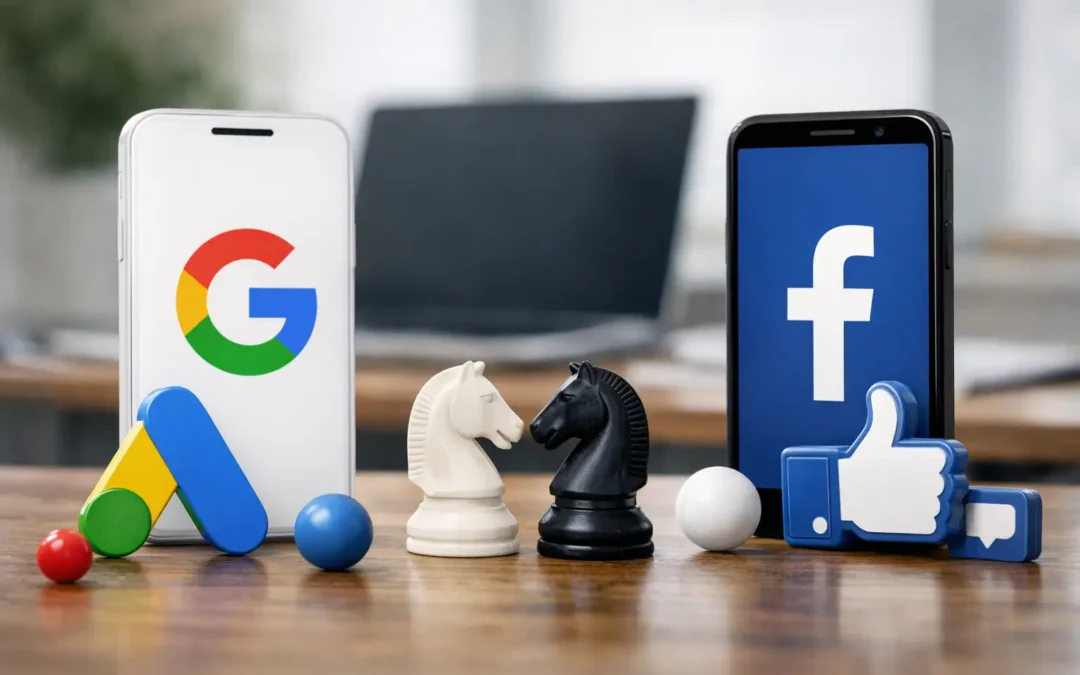
If your leads have slowed down and every agency pitch sounds the same, this is the question that actually matters: google ads vs facebook ads – where will your next customer come from, and what will that customer cost you?
For most Canadian businesses, the answer is not based on hype. It comes down to buyer intent, sales cycle, budget, and how quickly you need results. Google Ads can put you in front of people who are already searching for what you sell. Facebook Ads can create demand, stay in front of the right audience, and often generate attention at a lower top-of-funnel cost. Both can work. Both can also waste money fast if the strategy is wrong.
Google Ads vs Facebook Ads: The Core Difference
The biggest difference between Google Ads and Facebook Ads is intent.
Google Ads targets people based on what they are actively searching for. If someone types in “Calgary personal injury lawyer,” “dentist near me,” or “commercial roofer quote,” they are signalling a need right now. That makes Google Ads one of the strongest lead-generation channels for service businesses, local companies, and high-intent B2B campaigns.
Facebook Ads works differently. It targets people based on who they are, what they are interested in, how they behave online, and sometimes where they are in life or business. People are not usually on Facebook or Instagram looking for a lawyer, clinic, or software provider in that exact moment. They are scrolling. Your ad has to interrupt that behaviour and make them care.
That distinction matters because it shapes everything else – click-through rate, lead quality, sales speed, landing page strategy, and budget efficiency.
When Google Ads Usually Performs Better
If your business solves an immediate problem, Google Ads often has the edge.
Think about emergency plumbing, legal services, dental care, HVAC, mortgage brokers, accountants during tax season, or B2B services where prospects already know what they need. In these cases, search traffic converts because the intent is already there. You are not trying to educate the market from scratch. You are showing up at the exact moment someone is ready to compare options or buy.
This is why Google Ads tends to produce stronger bottom-of-funnel leads. The person searching is closer to action. That does not always mean lower cost per click. In many industries, especially legal, finance, and home services, clicks can be expensive. But a higher click cost can still be profitable if the lead quality is strong and your close rate is healthy.
For local businesses in Calgary and across Canada, Google Ads also pairs well with local SEO. Paid search can capture immediate demand while organic search builds long-term visibility. That combination is often far more effective than relying on paid social alone.
When Facebook Ads Usually Performs Better
Facebook Ads tends to win when your goal is awareness, audience building, remarketing, or demand generation.
If your service needs explanation, if your market is highly visual, or if your sales process takes time, Facebook and Instagram can be extremely effective. This is common for elective healthcare, franchises, coaching offers, home improvement, lifestyle services, events, and SaaS products with longer consideration cycles.
Facebook Ads also gives you strong creative control. You can use video, testimonials, before-and-after visuals, lead forms, and educational messaging to warm people up before they ever visit your site. That makes it useful for brands that need repeated exposure before a prospect converts.
The trade-off is lead intent. You may generate cheaper leads on Facebook, but cheaper does not always mean better. If your offer is broad or your targeting is too loose, you can end up paying for curiosity instead of real buying interest.
Cost: Which Platform Is Cheaper?
This is where many business owners get misled.
Facebook Ads often looks cheaper on the surface because impressions and clicks can cost less than Google Ads. But if those clicks do not turn into qualified calls, booked consultations, or closed deals, the lower cost means very little.
Google Ads often has a higher upfront cost, especially in competitive industries. Still, the economics can work better because the traffic is more qualified. A campaign that costs more per click but delivers ready-to-buy leads can outperform a cheaper campaign that brings in volume without intent.
The real metric is not cost per click. It is cost per qualified lead and cost per acquisition.
A law firm that pays more for a high-intent Google click may still come out ahead. A fitness brand promoting a limited-time offer might get better returns through Facebook because it can scale reach and remarketing more efficiently. It depends on the value of the customer, the strength of the offer, and how well your sales process converts interest into revenue.
Targeting and Control
Facebook gives advertisers more audience-based targeting options. You can shape campaigns around demographics, interests, behaviours, retargeting pools, and custom audiences. That is powerful if you know your buyer profile and have strong creative.
Google gives you access to intent-based targeting, which is often more commercially valuable. Keywords, location targeting, device adjustments, ad extensions, and search themes help you line up with active demand. For many lead-generation businesses, that is the kind of control that matters most.
There is a practical issue here too. Facebook targeting is only as good as your messaging. You can reach the right audience and still fail if your creative does not stop the scroll. On Google, the challenge is different. You need the right keyword mix, ad copy, and landing page experience to convert expensive traffic.
Both platforms require skill. Neither is plug-and-play.
Google Ads vs Facebook Ads for Lead Quality
If your business depends on phone calls, booked estimates, or consultation requests, Google Ads usually produces better lead quality.
That is especially true for legal practices, medical clinics, contractors, local service companies, and B2B providers with clear demand. Searchers are self-identifying as prospects. They are telling you what they want.
Facebook can still deliver leads, but quality control becomes more important. Instant lead forms can generate volume, though sometimes with weaker intent. Website conversion campaigns can improve quality, but they depend heavily on landing page strength and follow-up speed. If your team is slow to respond, Facebook leads go cold fast.
For businesses with strong sales teams and good nurture systems, Facebook can become a profitable lead source. For businesses that need high-intent leads quickly, Google is usually the safer bet.
The Best Choice for Canadian Businesses
For most service-based Canadian businesses, Google Ads should be the first paid channel to test if there is clear search demand for your service.
Why? Because it is easier to tie search intent to revenue. If people in your area are actively looking for what you do, you want visibility there first. That applies to local services, clinics, legal firms, trades, and many B2B categories.
Facebook Ads becomes more attractive when you need to build familiarity, retarget visitors, support seasonal promotions, or stay in front of prospects who are not ready to buy on day one. It also works well as a second channel once your search campaigns are stable.
That is often the smartest growth path. Start with high-intent traffic. Then layer in Facebook and Instagram to build brand recall, nurture warm audiences, and recover missed opportunities.
At SEO Pros Canada, this is usually how we look at it: not as a platform debate, but as a revenue decision. The right channel is the one that fits your sales cycle, margins, geography, and lead quality requirements.
Should You Run Both?
In many cases, yes.
Google Ads captures demand. Facebook Ads helps create it, reinforce it, and retarget it. Used together, they can cover more of the customer journey. Someone may first see your brand on Facebook, search for you later on Google, then convert after a remarketing ad reminds them to act. That path is common, especially in competitive markets.
The caution is budget. Running both platforms with a small budget can spread results too thin. If you only have enough budget to test one properly, choose the platform that matches your current business need. If you need leads now, Google usually comes first. If you need market education or repeat exposure, Facebook may deserve the first shot.
Creative quality, landing pages, tracking, and follow-up speed will influence results more than platform choice alone. A weak offer will underperform on both.
So Which One Wins?
If you want the shortest path to high-intent leads, Google Ads usually wins.
If you want lower-cost attention, stronger audience nurturing, and more room for creative storytelling, Facebook Ads often wins.
The better question is not which platform is universally best. It is which platform is best for your business right now. A Calgary contractor, a dental clinic, and a SaaS company should not all make the same decision.
Choose the platform that matches how your customers buy, not the one that gets talked about the most. That is where profitable marketing starts.